

Preview
Creation Date
4-25-1990
Description
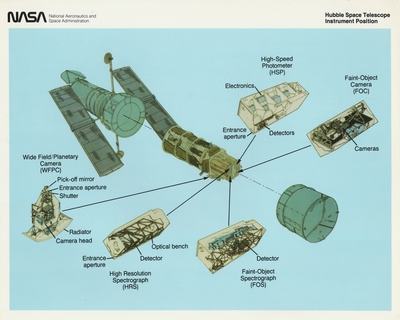
Hubble Space Telescope Instrument Position
The investigations conducted by the Hubble Space Telescope (HST) will be performed by five scientific instruments. These will be located behind the primary mirror, at the focal plane, where they can pick up light from the telescope. All of these instruments are American-made except for the Faint Object Camera (FOC), which will be provided by the European Space Agency (ESA).
All instruments are contained in separate modules. Four are in bays that are parallel to the axis of the spacecraft. The Wide Field/Planetary Camera (WFPC) is located in front of the axial bay at right angles to the other instrument modules. Each of these instruments will require between 110 and 150 watts of power. All are exchangeable during maintenance visits in orbit.
The instruments include two cameras, two spectrometers, and a photometer.
The FOC, provided by the ESA, and the WFPC are distinguished by their fields of view, spatial resolution, and wavelength range. Both instruments cover the ultraviolet and blue regions of the spectrum. The WFPC covers the red and near-infrared regions as well. The FOC has a very small field of view, but can use the highest spatial resolution that HST can deliver. The WFPC covers a field at least 40 times larger, but with a resolution degraded by a factor of two to four.
The two spectrographs, the High Resolution Spectrograph and the Faint Object Spectrograph (FOS), provide a wide range of spectral resolutions which would be impossible to cover in a single instrument. Both instruments will record ultraviolet radiation. Only the FOS covers the visible and red regions of the spectrum.
The fifth instrument, the High Speed Photometer, is a relatively simple device capable of measuring rapid brightness variability over time intervals as short as 0.0001 second. It also can be used to measure ultraviolet polarization and to calibrate other instruments.
In addition to these five instruments, the telescope's star trackers, needed to point the HST accurately toward astronomical targets, can be used to measure precisely the positions of stars in the sky.
The Goddard Space Flight Center, Greenbelt, Md., is responsible for the scientific instruments, mission operations, and data reduction. Scientists at Goddard monitor the development of these instruments and insure that the best possible scientific advice is given. The Goddard scientific team also assists project managers and engineers in areas related to the observatory's scientific performance, and serve as a liaison between the project, the principal investigators, and other participating scientists.