

Preview
Creation Date
8-3-1962
Description
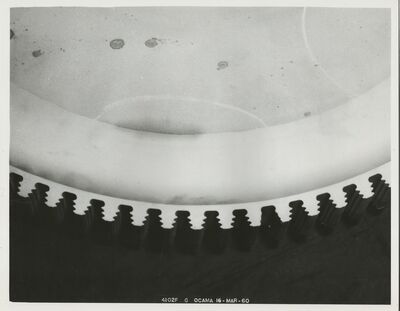
J47-25 Turbine Wheel p/n E 7032R96G3 s/n TPD 9230
Removed from J47-GE-25 engine s/n 075-228 on 12 Nov 1959 by 90th FMS.
Reason for removal shown on AFTO Form 44 as "Overtemperature, bucket missing due to dove tail splines broken."
This wheel is "necked down" in weld and in 4340 material just inside the weld. Both front & rear face of disc are severely cracked in several places just inside weld. This was a potential "chunk" type failure. Undoubtedly damage was caused by continued operation with the compressor in a stalled condition resulting in loss of turbine disc cooling and severe overtemperature. Extreme rim growth is evident. Original diameter of wheel was 26.726". After removal, wheel diameter was 26.856" or a growth of .130". Rim growth resulted in spread in the dove tail which allowed the bucket to shear the serrations. Three photos numbered 4102F are of this wheel.
Associated news article by Nashua Telegraph (4 Aug 1962, p.1) reads: "Pease AFB Plane Crash Kills Three - PEASE AIR FORCE BASE, N.H. - Three Airmen were killed in the crash of a B-47 jet bomber moments after takeoff from Pease Air Force Base last night.
The Air Force identified the victims as: Capt. Eugene S. Procknal, 31, of Buffalo, N.Y., the pilot, who leaves his widow and four children.
First Lt. Eric W. Epps Jr., 24, of Newport Newsm V.A., the co-pilot.
First Lt. Edward R. Sowinksi, 25, of Dover N.H., nagivator, who leaves his widow, a daughter, and his mother, Mrs. Mary Sowinksi of Newark, N.J.
Air Force officials said the plane was taking off for a scheduled training mission. A board immediately was set up to determine what caused the crash.
The Plane burst into flames upon crashing on the air base golf course. Officials said its three occupants died instantly.
Wreckage of the plane was scattered over a half-mile area. The plane just missed the gold course clubhouse before it crashed.
The six-jet bomber was attached to the 509th Bombardment Wing at the Strategic Air Command facility.
The fuel from the plane caused flames to spread over a large area of the golf course. Fire trucks from Portsmouth and other nearby communities rushed to the scene.
Airmen wearing asbestos suits were also on hand at the south-east end of the two-mile runway.
Traffic was backed up on Route 101, adjacent to the golf course, and policemen temporarily re-routed cars.
Col. James S. Howard, vice commander of the 100th Bomb Wing, was named president of the investigation board. Results of the inquiry were not expected for some days.
The last crash at Pease was Jan 4, 1961, when four were killed."